
Jay Jones’ Reckless View on Abortion Pills
Regardless of what Attorney General Jay Jones thinks, the abortion pill isn't safe. Not for the mother and certainly not for the baby.
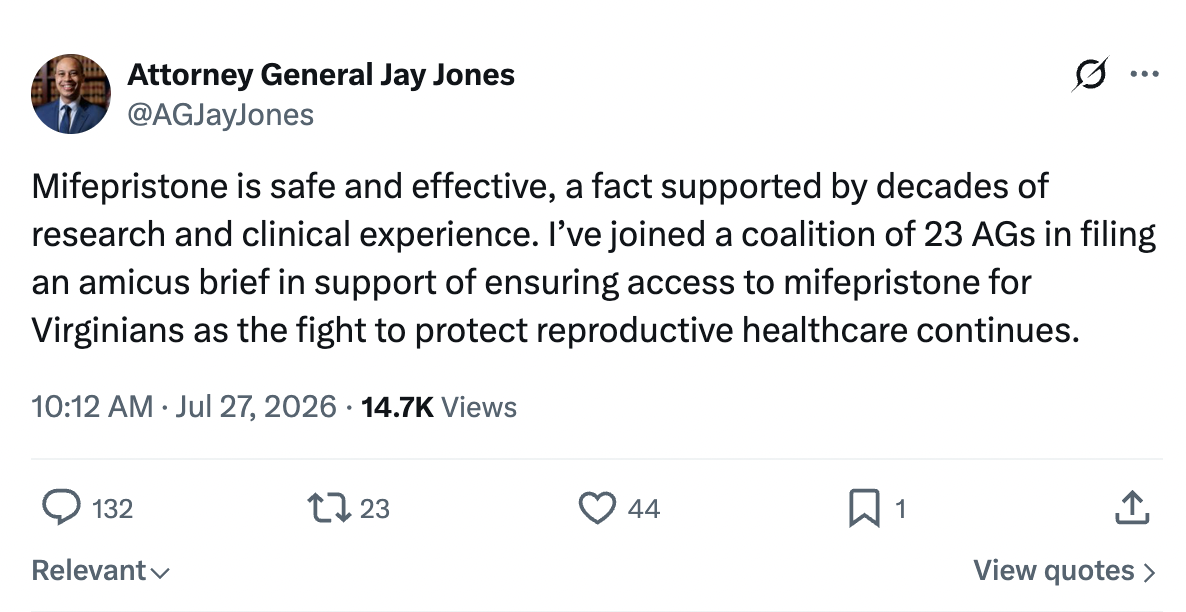
The Attorney General recently joined a coalition of 23 state AGs defending mifepristone, calling it "safe and effective." It's the latest example of Jones getting the facts wrong on an issue that affects the health and lives of Virginia women.
First, abortion is not healthcare. Ending the life of an unborn child is completely counter to treating a patient's illness or injury and providing life-saving treatment, and no political coalition letter changes that.
Second, and just as important, Jones's “safety” claim doesn't hold up to scrutiny.
Current reports refute “safe and effective” claims
The current FDA safety data behind mifepristone is derived from decades-old data covering roughly 31,000 women, of whom under 0.5% reportedly had severe adverse reactions.
However, a 2025 analysis by the Ethics and Public Policy Center (EPPC) which examined insurance claims data covering 865,727 mifepristone abortions from 2017–2023, gives a current and more accurate understanding of the chemical's dangerous effects. Here are some key findings.
10.93% of women experienced sepsis, infection, hemorrhaging, or another serious/life-threatening adverse event — over 1 in 10 patients.
The adverse events are 22 times higher than the adverse event rate on the current FDA label.
The authors argue the gap reflects, in part, the loosening of safety protocols (removal of in-person dispensing requirements, expanded telehealth prescribing) under recent administrations.
Other Concerns Ignored by the Attorney General
Severe Complications: 20% of all chemical abortions result in incomplete abortion, retained products, ectopic pregnancy rupture, uterine rupture, hemorrhage, sepsis, and death, which is 4 times more than the rate of surgical abortions. Severe risk increases when the abortion pills are dispensed through telemedicine.
Excruciating pain: A Finnish Study found that 58% of women experience "severe" pain, with some saying "it was the worst pain in their life."
Lack of in-person physician oversight: Removing in-person exam requirements strips away safeguards that are used to catch ectopic pregnancies and other complications before the drug is administered.
No follow-up guarantee: Telehealth prescribing means many women never have an in-person follow-up to confirm the abortion is complete, raising the risk of undetected retained tissue, infection, or continuing pregnancy going unmanaged.
Environmental/water supply concerns: The FDA has failed to adequately determine the harm caused by mifepristone and its byproducts entering wastewater treatment systems through excretion.
Jay Jones signed onto a talking point, not a fact. Before Virginia's AG puts his name behind a national coalition defending this drug, his constituents deserve to know that the study used to support mifepristone outcomes dramatically understates the risks. And that recent studies like the EPPC's provides a much clearer picture of the dangerous outcomes that accompany these drugs.
As they say, it’s time to follow the science!