
Patriotism Is Not Ignorance
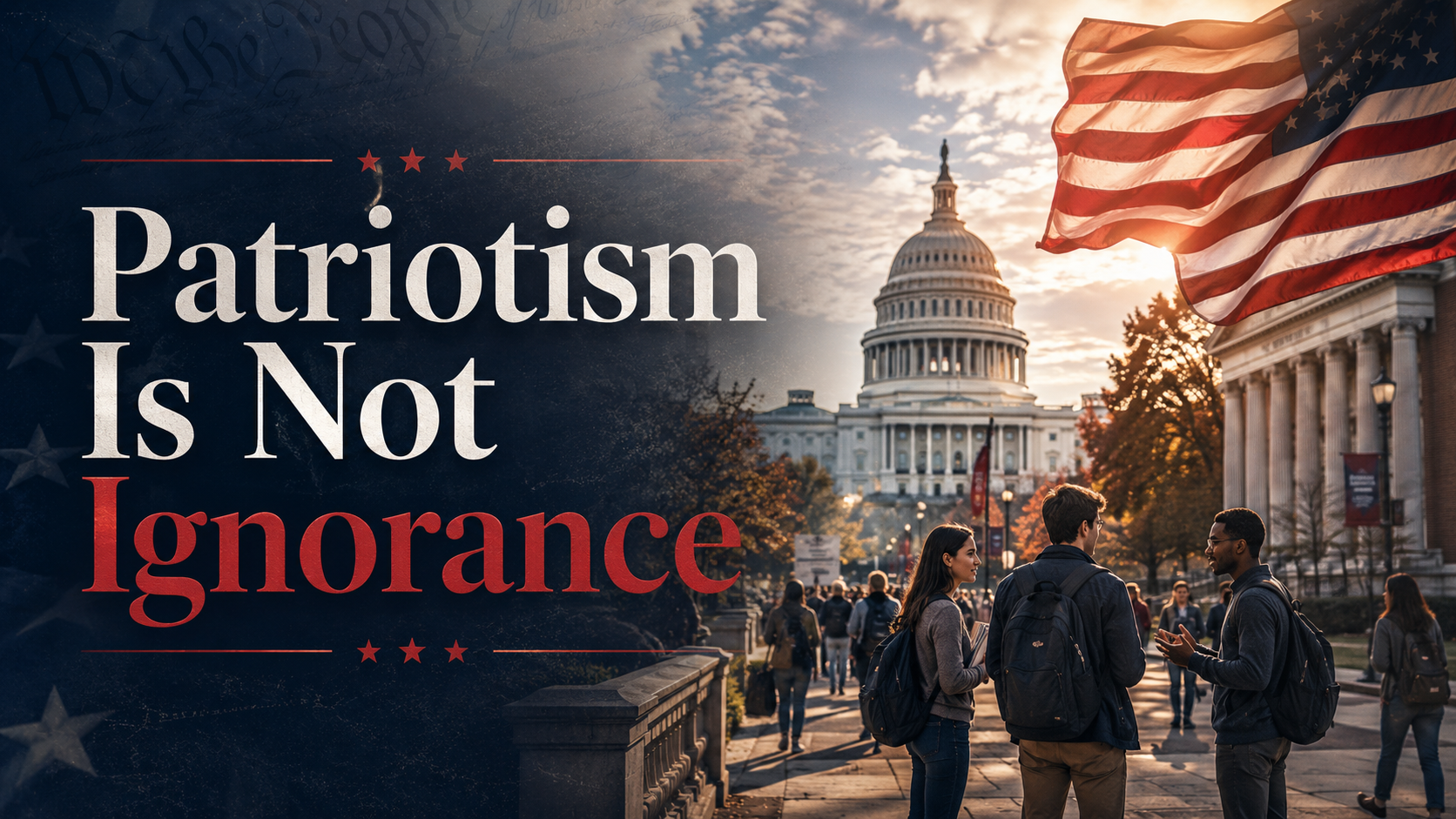
On many college campuses across the country, criticism of America’s founding is often treated as a sign of intelligence or cultural awareness. Students are taught to view America through the lens of its sins: colonialism, slavery, inequality, oppression, capitalism, the list goes on.
All the while, patriotism is dismissed by professors and students as naive or unenlightened.
Certainly, Americans should not turn a blind eye to America’s historied past; but no student should be belittled for love God and Country. There are many good lessons to be learned from American history and applied for the future generations who will inherit the reigns of power.
However, Americans are starting to see the manifestation of academic criticisms against America take form in the walls of Congress. Recently, in New York Democratic Congressional Primary Elections, two Democratic Socialist of America (DSA) candidates won the primary in heavy blue districts; essentially locking them in a seat in the House chamber.
Recent primary wins in New York and Colorado bring the total up to 4 DSA candidates ‘vying’ for a seat in Congress this November.
A seat in the very chamber where, not so long ago, our founding leaders fought vigorously to defend the ideals and principles that secured the freedoms Americans still enjoy today.
In this week’sSpeak Up! Virginia podcast, Victoria Cobb puts it plainly, “there’s a fundamental desire to break down all that is Western Civilization.” Adding that “they don’t understand what capitalism has brought them. They don’t understand what socialism actually would do, what it would actually look like”
What happens when an entire generation is taught that America's founding ideals are irredeemably corrupt? What comes next? What will replace the institutions and principles being rejected?
This is not to say that criticism is the enemy, America’s failures should be examined honestly. However, criticism should not become destruction. Destruction assumes that the founding principles were never worth preserving in the first place.
When freedom, self-government, faith, family, and limited government are treated as obstacles rather than safeguards, the result is not progress. It is a vacuum waiting to be filled by something far more controlling.
Many young Americans have legitimate concerns about the world they are inheriting. Housing costs are high. Student debt is real. Jobs can feel unstable. It is somewhat understandable that sweeping promises of affordability, equality, and security can sound appealing.
But political ideas should not be judged only by the compassion of their promises. They should be judged by what they require to make those promises happen.
When government is expected to solve every problem, someone must decide what counts as a problem, what solutions are acceptable, and how much power is necessary to enforce them. That power does not remain limited to taxes or economic policy. It reaches into education, health care, religious expression, family life, private business, property, and speech itself.
The irony is that many of the loudest criticisms of America are possible because of the very freedoms America protects. Students can challenge elected officials, criticize professors, organize protests, speak openly about politics, and argue for entirely different systems of government. Those freedoms are not automatic. They were secured through a system that recognizes human dignity, limits government power, and protects the right to dissent.
Patriotism does not require pretending America has never failed. It does not require ignoring injustice or refusing to learn from history. In fact, a healthy love of country should make Americans more willing to confront wrongs and work toward a better future.
But there is a difference between calling America to live up to its ideals and insisting that those ideals should be discarded altogether.
Cynicism can sound sophisticated. Contempt can be mistaken for moral clarity. Yet neither one can build a freer, stronger, or more just country.
Before celebrating movements built on resentment toward America’s foundations, students and voters alike should ask what will stand in their place. Will it be a nation with more freedom, more dignity, more opportunity, and more room for faith and family? Or will it be one where promises of fairness slowly become excuses for greater control?
It is easy to criticize America from a college campus. It is harder—and far more necessary—to ask what could be lost if the principles that protect freedom are torn down.
-This Blog Post was written by one of our Summer 2026 College Interns!