Addiction-for-Profit Marijuana Bills Advance
Urge your Delegate and Senator to OPPOSE an addiction-for-profit marijuana retail market!
On Friday, a Senate committee and a House committee both advanced legislation creating a retail market for recreational marijuana. As we have stated consistently for more than five years, since the General Assembly first decriminalized certain amounts of marijuana, creating a commercial framework for selling marijuana is harmful to families and communities.
As this legislation now moves through the process, one of its most troubling omissions is the lack of a local opt-out. Last month, Delegates Paul Krizek (D) and Will Morefield (R), and Senator Lashrecse Aird (D), coauthored an op-ed supporting a retail marijuana market and defending a policy that would deny localities the authority to completely prohibit marijuana storefronts in their communities.
They argue that “allowing local opt-out is opting into the illicit market.” However, evidence from states with legal retail markets directly contradicts this claim. Experts at Smart Approaches to Marijuana (SAM), analyzing real-world data, have shown that localities that ban marijuana storefronts actually experience lower rates of problematic marijuana use and lower rates of adolescent marijuana use. Based on their research, here are some myths about marijuana commercialization.
MYTH 1: WE CAN HAVE AN "ADULT-USE" RETAIL MARKET THAT PROTECTS YOUTH.
States that have legalized marijuana have seen a growing illicit market and increasing rates of youth drug use. In states that have legalized “adult-use” marijuana, 12–17-year-olds have experienced a 25% increase in marijuana use disorder compared to states that have not legalized. (Cerda, et al., JAMA Psychiatry, 2019)
MYTH 2: A RETAIL MARIJUANA MARKET WILL STOP THE ILLICIT MARKET.
No state has eliminated, or even reduced, the illicit marijuana market. In California, an estimated 70–80% of marijuana sold in legal pot shops was produced and grown illegally, demonstrating the failure of the “tax and regulate” model. (SAM, Policy Impact Report: 2023-2024)
MYTH 3: LOCAL RETAIL BANS/OPT-OUTS (“DRY LOCALITIES”) ARE INEFFECTIVE
Research shows that retail opt-out localities have lower overall cannabis use, lower rates of problematic use, lower adolescent use, fewer marijuana-related anxiety and depressive disorders, and fewer adverse outcomes, in part because of greater distance from retail outlets. (American Journal of Public Health, 2024). States with legal marijuana continue to experience thriving black markets and rising youth use, proving that "adult-use" retail access does not solve these problems. Untaxed marijuana will always be cheaper and more attractive on the illicit market.
MYTH 4: MARIJUANA WILL GENERATE SIGNIFICANT TAX REVENUE.
In states that have established a retail market, cannabis tax revenue accounts for less than 1% of total state budgets, far below what advocates promised. A Colorado study found that for every $1 in marijuana tax revenue, the state spends $4.50 addressing the costs associated with legalization. (CCU, 2017)
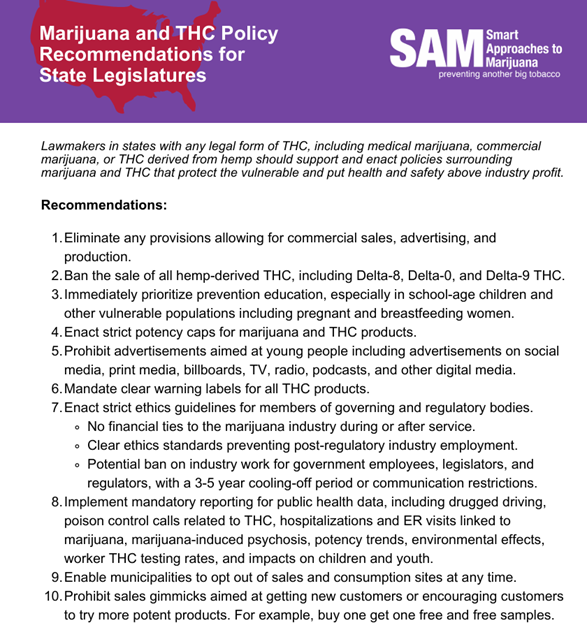
If lawmakers are serious about addressing the illicit market, SAM offers a list of meaningful, evidence-based policy alternatives, in addition to supporting law enforcement and allowing them to do their jobs, that do not involve creating a retail marijuana industry. Virginia has already enacted some of the recommendations below.
The cannabis lobby is working aggressively to establish another Big Tobacco–style industry in Virginia. Make no mistake: the companies and lobbyists filling committee rooms are not focused on regulation, youth protection, or saving lives. They are pursuing an addiction-for-profit business model, and too many lawmakers appear to be captivated by promised revenues rather than the long-term costs to public health and community well-being.